
By Nicola Whittaker, Business Development Manager
When choosing a new tumble dryer, it’s easy to assume that a domestic machine will be the cheaper option due to a lower upfront cost. However, the reality is different.
In many commercial environments, a professional dryer can recover its higher purchase cost often within one year, purely through reduced energy consumption.
Why does a commercial dryer use less energy and save you money?
A big factor is cycle times. Commercial dryers are designed to complete cycles significantly faster than domestic machines. This has two direct benefits:
- lower energy usage per load
- higher throughput, allowing more laundry to be processed in the same time
Because more laundry can be processed in the same time, this means fewer machines are required.
Savings example
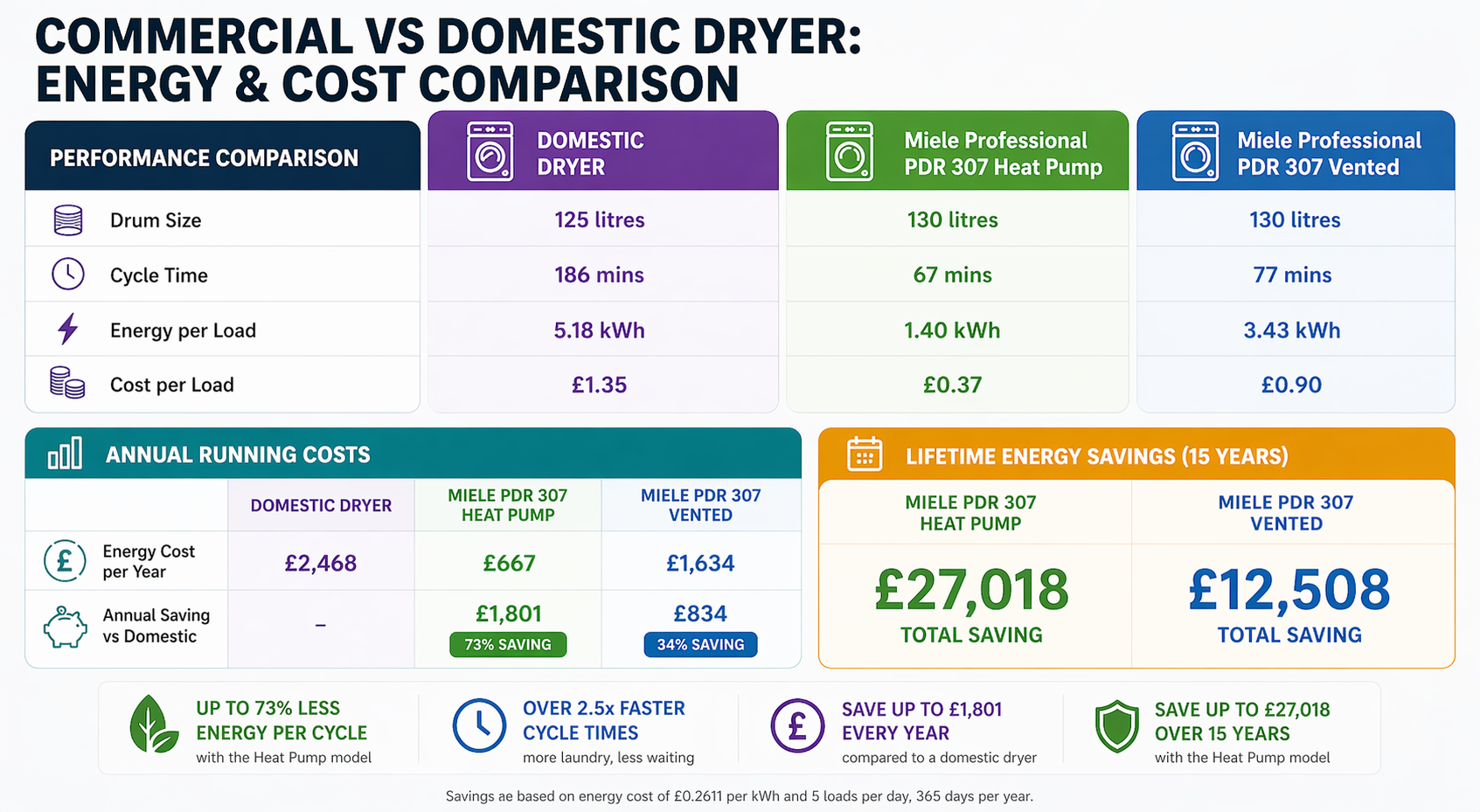
Moving from traditional domestic condenser dryers to commercial heat pump dryers provides even bigger potential savings.
Comparing a traditional domestic 9kg dryer with Miele Professional Little Giant commercial dryers (in this example, the PDR 307 vented and heat pump models), you can achieve:
- Annual energy savings of £1,801
- Lifetime savings exceeding £27,000
- Miele Professional commercial dryers tested to 40,000 cycles, supporting long term reliability
Key performance highlights
- The Miele Professional PDR 307 Heat Pump reduces energy use by approximately 73% per cycle compared to a typical domestic 9kg dryer
- Cycle times are over 2.5x faster, increasing throughput significantly
- Annual savings of £1,801 make the commercial machine financially compelling
- Over a 15-year lifespan, savings can exceed £27,000
The vented model still offers meaningful improvements, but the heat pump model delivers the strongest long-term return.
Drum capacity confusion
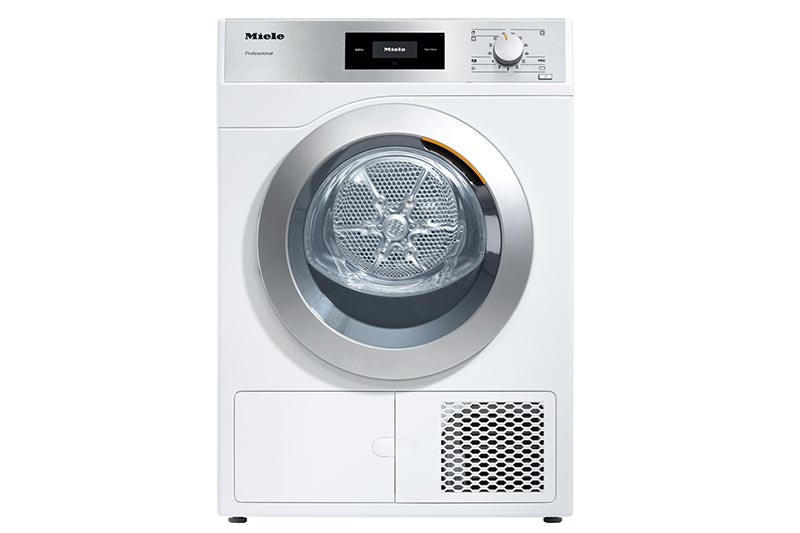
At first glance, domestic dryers often appear larger on paper than commercial machines. For example, in the example above, the commercial tumble dryers are stated as 7kg capacity, whereas the domestic dryer is stated as 9kg capacity. This is misleading.
Domestic manufacturers often boost the stated capacity based on maximum load weight. In contrast, commercial machines use a more conservative rating to represent optimal load size for best drying performance. This is because tumble dryers work most efficiently when air can circulate freely through the load.
In the comparison, the domestic drum size is 125 litres, compared to 130 litres for the commercial machines. So despite the lower stated kg rating, the commercial machines offers greater usable space. The increased stated domestic dryer capacity is down to marketing and how capacity is measured, rather than a genuine increase in usable space.
Summary – are domestic dryers really cheaper?
In simple terms, no. While the domestic dryer may appear more affordable initially, they typically result in:
- Higher running costs
- Slower cycle times
- Shorter lifespan
- Greater equipment requirements
By contrast, commercial dryers deliver:
- Lower energy costs
- Faster throughput
- Fewer machines required
- Long-term reliability
With payback often achieved within the first year, and energy savings of £27,000 over the lifetime of the tumble dryer, commercial tumble dryers are typically the more cost-effective choice.
About the author
Nicola Whittaker works with commercial laundry clients, helping businesses reduce energy costs and improve operational efficiency. You can learn about Nicola on our Meet The Team – Nicola Whittaker page, or contact on 0113 2572221 or nicola@jtmservice.co.uk
Need advice on commercial tumble dryers?
JTM Service specialises in commercial laundry equipment, helping businesses choose the most cost-effective and energy-efficient solutions. Call 0113 2572221 or email info@jtmservice.co.uk to discuss your requirements.