
Wendy McLorg is Business Development Manager for JTM Service and has over 30 years’ experience supporting customers with their commercial laundry and dishwashing requirements. In this article, Wendy discusses the difference between commercial and domestic laundry equipment, including the risks and the benefits of selecting the right equipment.
Introduction
I am Wendy McLorg and I am a Business Development Manager for JTM Service. My role focuses on building client relationships, negotiating competitive deals, and ensuring our customers receive the best value and service.
What is “commercial laundry equipment”?
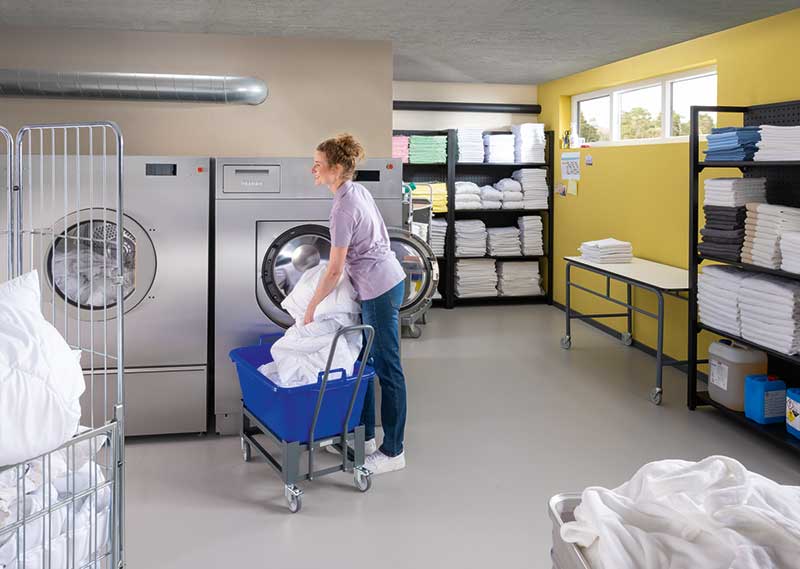
Commercial laundry equipment is a step up from the domestic market, and it is designed for use in commercial premises. They are needed wherever you have high volumes of washing to be done, and they enable compliance with hygiene standards and water regulations, which is critical. Examples of where they are used include Care Homes, Hospitals, Housing Associations, Prisons and Hotels.
What are the main differences between commercial and domestic laundry equipment?
Domestic machines are designed for lighter, occasional use and are typically found in households. They have smaller capacities and are not built to handle frequent, high-volume loads.
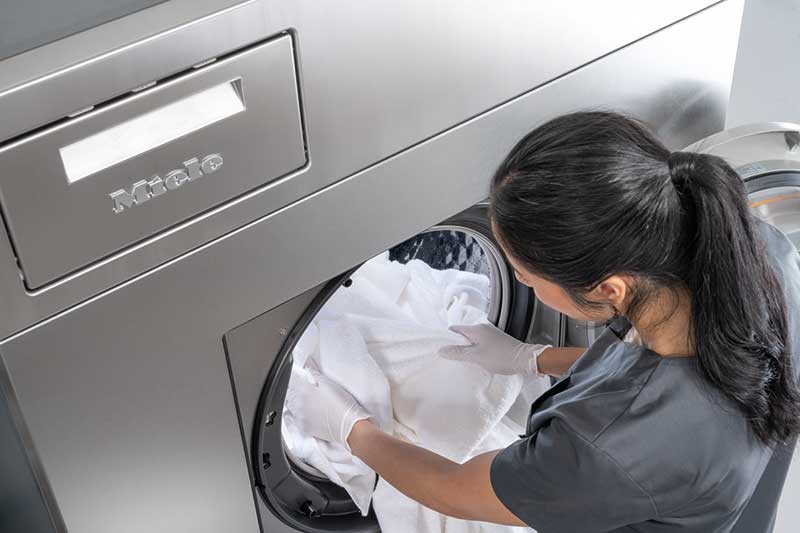
Commercial washing machines, tumble dryers and ironers, on the other hand, are engineered for durability and heavy-duty performance. They are compliant with legislation, for example the exacting hygiene standards required in care and healthcare settings, and with the water regulations which apply for all businesses. Commercial laundry machines have faster cycle times, and can cope with a much higher volume of laundry and withstand multiple cycles per day, making them ideal for demanding environments such as care homes, hotels, and laundries to name but a few.
Commercial machines can come in traditional single phase, 230V supply with a 13amp fuse. However, they can also come in a range of other electric requirements (e.g. higher amps, or 3 phase/400V supply). Tumble dryers and ironers can also be gas powered. These different power supply requirements enable commercial machines to be much faster, more efficient and cope with increased loads and capacities.
What are the key benefits of commercial laundry equipment vs domestic laundry equipment?
The key benefits of a commercial machine are:
- Durability – they are robust and built to last
- Speed and efficiency – the cycles will be faster, and they are more efficient than domestic machines, with reduced energy and water usage
- Capacity – sizes range from 7kg capacity up to 32 kg and above, allowing the site to be able to get the right size of machine for their needs.
- Programmes – they have additional programmes designed for the market sector that is needed
- Compliance – commercial washers and dryers are designed to meet current legislation which applies to businesses and the relevant sectors.
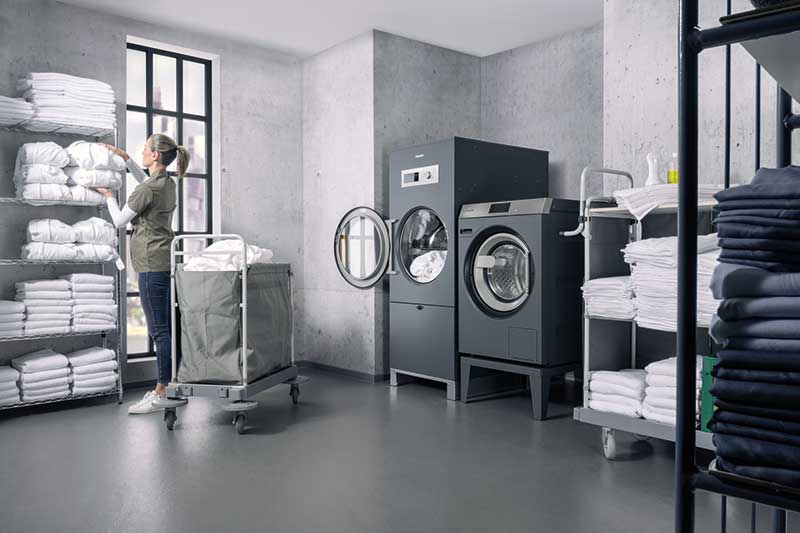
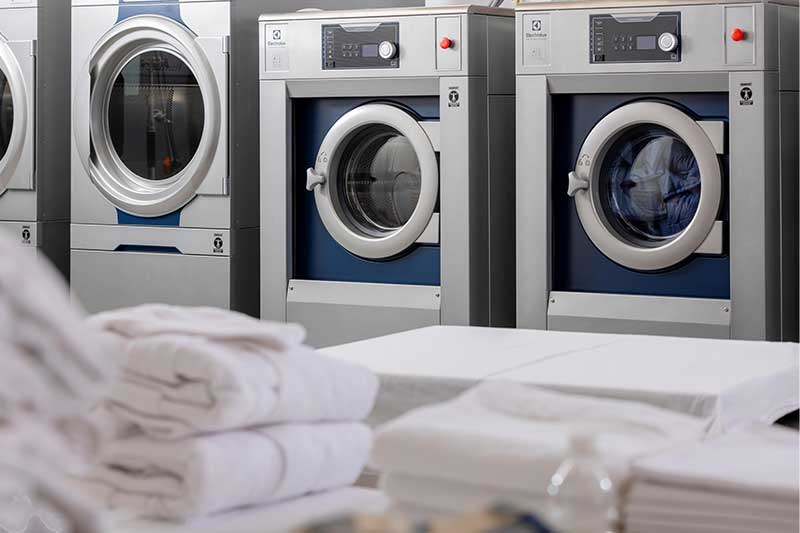
- Performance – commercial machines from leading suppliers such as Miele Professional and Electrolux Professional include additional features for performance, such as higher spin speeds, reverse action and drums designed for gentle fabric care.
Which types of businesses require commercial laundry equipment?
All business with a laundry requirement should use commercial laundry equipment. This includes NHS Hospitals, the Care Sector, Prisons, Hotels, Veterinary Practices, Housing Associations, Laundrettes, Student Accommodation, Campsites – again, anywhere where there is a high volume of laundry per day.
What are the main risks with using domestic equipment in a commercial setting?
The main risks of using domestic machines is a commercial environment are:
- Warranty – the machines warranty will be null and void if used in a commercial environment. This means any repairs or replacements will be at your own cost
- Programmes – the machine is unlikely to be programmed for the sites needs
- Compliance – a domestic washing machine will not be certified to meet the water regulations, and may not be to current legislation specific to the market sector it is being used in
- Breakdowns & repairs – a domestic washer or dryer is not designed for commercial use, and will breakdown more often and not last, leading to costly repairs and downtime, and ultimately needing replacing
- Hygiene – care and healthcare settings need to meet specific requirements which can only be achieved with commercial washing machines (for example, disinfection programmes and a gravity drain)
How have commercial laundry machines evolved since you first started in the industry?
I have been in this industry for over 30 years and in that time machines have changed greatly. The dimensions have changed, having to adapt to get the right capacity into smaller spaces. Programmes have changed, giving the customer more choice and the flexibility to have the programmes specific for them. Legislation changes all the time and manufacturers have to adapt their equipment to keep up.
More than anything, machines are much more energy efficient. This is a major thing when you are using machines day in and day out – they have shorter cycles and use less water, which means less heating (less electricity). Washing machines have much faster spin cycles which means less residual water, which in turn means less drying time is required.
Condenser Dryers are very rarely used in the commercial sector anymore, and have been replaced with Heat Pump technology. Condenser dryers were primarily used when you couldn’t vent your dryer out, but they were inefficient. Heat pump dryers are now used to replace them, and they can be over 60% more efficient.
What is a common misconception people have about commercial laundry equipment?
I think there are a lot of sites that are not aware of legislations for their industry, and think domestic machines are cheaper and fine to meet legal standards. However, some industries will have domestic machines in when they shouldn’t have.
Domestic machines may be cheaper up front than commercial machines, but they are less efficient, less durable and less robust. They will breakdown much more often, will not be able to meet the demands put on them and need replacing regularly. In this way the costs over time will be higher than good quality, commercial laundry machines.
For compliance, all businesses need to meet water regulations (The Water Supply (Water Fittings) Regulations 1999), and domestic washing machines are not certified for this. Also, in the care and healthcare sectors, it needs to have a sluice cycle and meet the standards in NHS England’s Health Technical Memorandum (HTM 01-04). It needs to be gravity drained, into a closed drain and not a standpipe. Any sites that have vulnerable people or children should meet these standards, or anywhere there is contaminated, foul or infected laundry.
Who are the best manufacturers of commercial laundry equipment?
I would say without a doubt Miele Professional, they are a global leader, closely followed by Electrolux Professional in my opinion. With Miele, you get the longevity, less down time and the energy savings and the quality you would expect from machines designed and manufactured in Germany. Electrolux is also a high-quality brand, they manufacture robust machines which mix high performance with energy savings.
I have been working with Miele Professional equipment for well over ten years now and it’s a brand I have every faith in. I have key accounts that have communal laundries, and it never fails to amaze me that there are still some machines in there which are over 25 years old and still going strong!
How can JTM Service help businesses select the right machines for them?
We have over 40 years’ experience at JTM Service, and we work with all major manufacturers and can therefore supply and install the best equipment for each customer.
For customers with existing equipment, at JTM Service we look at each individual site, identify the make and model, analyse the state of the machine, and review the service history of the machine along with what the client needs to be able to get the job done. We can then advise what is best for them, taking into account their specific needs, the volume of laundry and timescale needed to get it all done, and the type of machine that is right for them.
Where a customer needs additional new equipment, either for increased capacity or on a new build, we will do the same, understanding the customer requirements first to ensure the right machine for them, taking into account space, volumes required, budget, space, and anything else specific to that customer. We also offer flexible payment terms to best suit the customer’s needs. I have always worked on the premise that I give the customer all the facts, give them options to best suit them, offer advice, and let them make the decision that is best for them.
And, with our specialist in-house installation team, who are experienced and specifically trained by manufacturers, we can ensure the commercial laundry equipment is installed quickly and compliantly.
By Wendy McLorg, Business Development Manager, JTM Service